Arctic Shipping Gold Rush: South Korea’s Gamble Could Reshape Global Trade—But at What Climate Cost?
South Korea sends its first container ship through the Arctic route, but environmental scientists warn the 40-day shortcut could trigger a climate catastrophe that accelerates ice melt.
Table of Contents
What Is South Korea’s Arctic Shipping Experiment?
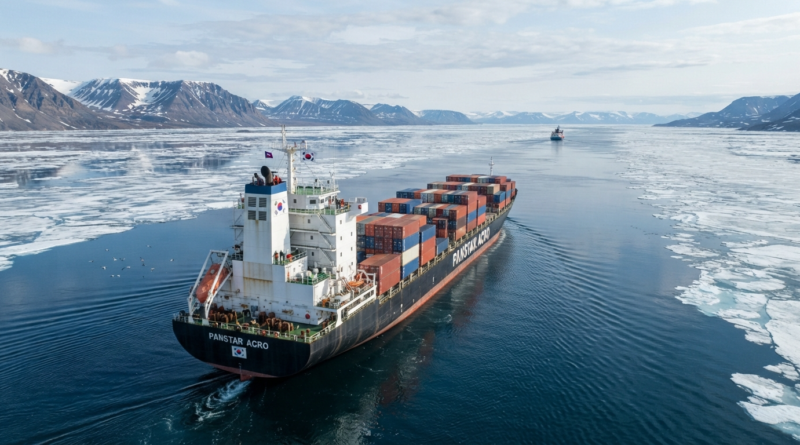
On August 22, 2026, South Korea embarked on a historic and controversial journey. The PanStar Acro, a 2,758 TEU container ship, departed from Busan New Port and set sail for Europe via the Arctic—marking the nation’s first commercial voyage through a route that didn’t exist just a few decades ago.
This isn’t a reckless corporate venture. The PanStar Acro voyage is government-backed, carefully planned, and loaded with 837 TEU of cargo including auto parts, chemical products, and empty containers. The ship is crewed by 20 Korean and Indonesian sailors who will guide the vessel through one of Earth’s most treacherous waters. The journey to Europe—with stops in Felixstowe (UK), Rotterdam (Netherlands), and Gdansk (Poland)—is expected to take approximately 40 to 45 days.
For South Korea, this voyage represents far more than a shipping experiment. President Lee Jae Myung has made Arctic shipping a national priority with ambitious goals: transform the port of Busan into a global maritime hub and establish the Arctic as a regular, scheduled trade route by 2030. The stakes couldn’t be higher. China is already launching regular container services through the Arctic, and South Korea fears being left behind in what could become the most significant shift in global trade patterns since the opening of the Suez Canal.
Seoul’s Ministry of Oceans and Fisheries announced the departure at 9:30 PM local time, marking the beginning of what officials hope will be a triumph of Korean maritime innovation and positioning in an era of climate-altered geography.
How Much Time & Money Can This Route Save?
The numbers driving this Arctic gamble are compelling. According to the Korea Institute for International Economic Policy, shipping via the Northern Sea Route can reduce journey distances by approximately 7,000 kilometers (4,300 miles) compared to traditional Suez Canal routes. This translates to roughly 10 fewer days at sea for an Asia-Europe voyage.
Real-World Savings: In practical terms, a voyage from Shanghai to Rotterdam via the Arctic can be up to 30% shorter than the traditional Suez route, shaving critical days off shipping schedules and reducing fuel consumption significantly.
South Korea’s Vice Oceans Minister Nam Jae-hon emphasized that the Arctic route is “bound to become an alternative” to Middle Eastern shipping lanes, particularly given ongoing tensions affecting traditional routes. The Suez Canal faces constant disruption risks, while the Strait of Hormuz remains a geopolitical flashpoint. The Arctic, by contrast, offers a route largely outside major conflict zones—for now.
Insurance premiums remain a significant hurdle, however. While fuel and time savings are substantial, insurance costs for Arctic voyages can be 5 to 10 times higher than conventional routes due to increased operational risks. Ice conditions, extreme weather, remoteness, and limited rescue infrastructure all drive up insurance expenses dramatically.
Despite these costs, major logistics experts believe the economic case for Arctic shipping will strengthen as more vessels make the journey, operational experience accumulates, and supporting infrastructure develops. The question is whether environmental costs will ultimately outweigh economic benefits.
The Environmental Nightmare Nobody Wants to Discuss
While South Korean officials celebrate the PanStar Acro’s departure, environmental scientists are sounding alarm bells about what increased Arctic shipping means for the planet’s climate future. The contradiction is stark: the Arctic route only exists because of climate change, yet using it accelerates climate change further.
The Climate Paradox: The Arctic warms approximately four times faster than the global average, which has created these new shipping lanes. But increased shipping in the Arctic will accelerate this warming, creating a vicious feedback loop of environmental destruction.
Research published in Nature Communications reveals alarming projections. Arctic Sea Route access will increase global shipping emissions by 8.2% by 2100, with Arctic-specific emissions rising from 0.22% to 2.72% of total shipping emissions. While this may sound modest in percentage terms, the environmental impact on a fragile ecosystem is potentially catastrophic.
The primary culprit is black carbon emissions. Ships using heavy fuel oil release soot and black carbon particles that settle on Arctic snow and ice, making them darker and more prone to melting. According to the International Council on Clean Transportation, this black carbon creates a vicious cycle: darker ice absorbs more heat, melts faster, opens more shipping lanes, which attracts more ships, which emit more black carbon, accelerating ice loss further.
Sian Prior, lead adviser for the Clean Arctic Alliance, warns: “It ends up in a never-ending cycle of increased warming.” The Paran Ocean Citizen Science Center in South Korea explicitly noted that “making the route commercially viable would require further warming, putting the policy at odds with efforts to combat climate change.”
Additional environmental risks include:
- Oil Spill Catastrophe: An accident in the remote Arctic would be virtually impossible to contain. Rescue capabilities are minimal, cold temperatures prevent cleanup technologies from working, and the pristine ecosystem would suffer irreversible damage.
- Ecosystem Disruption: Arctic marine life, including polar bears, seals, and fish populations, faces increased noise pollution, ship strikes, and pollution from increased traffic.
- Infrastructure Gap: There are virtually no ports, refueling stations, or rescue infrastructure along the Northern Sea Route, increasing accident risks dramatically.
- Air Pollution: Shipping emissions contribute to localized air pollution affecting Arctic communities and wildlife.
Why Western Allies Are Worried
Beyond environmental concerns, South Korea’s Arctic voyage creates significant geopolitical friction with Western allies. The issue is deceptively simple: using the Northern Sea Route requires Russian cooperation and navigation support, including weather data and ice condition updates.
Experts warn that even small payments to Russian authorities for navigation services could technically breach Western sanctions imposed on Russia for its invasion of Ukraine. South Korea’s Foreign Ministry has declined to clarify whether it consulted with the United States and NATO allies about potential sanctions implications—a telling silence.
The geopolitical context matters enormously. The war in Ukraine has made Arctic cooperation increasingly fraught. Western nations want to isolate Russia economically and politically. Russia views the Arctic as critical to its future economic development. And now Asian nations like South Korea are attempting to navigate (literally and figuratively) between these competing interests.
China has already launched regular container services through the Arctic and views the route as a strategic advantage. South Korea doesn’t want to fall further behind. India is planning its own pilot Arctic voyage for 2027. This emerging “Arctic race” mirrors broader Asian economic competition, but with the added complication of requiring Russian participation and cooperation.
The Trump administration’s general lack of action on Russian sanctions—combined with Europe’s aggressive sanctions regime—creates uncertainty about what Western powers will actually tolerate regarding Asian Arctic shipping operations.
Is Arctic Shipping Actually Commercially Viable?
Despite the economic and environmental obstacles, major shipping firms are beginning to test Arctic viability. Last year, 103 transits were made through the Arctic route by 88 vessels—up from 97 transits in 2024 and just 43 in 2022. This trend represents rapid growth, though still modest in absolute numbers.
However, major international carriers remain hesitant. CMA CGM, MSC, and Hapag-Lloyd—three of the world’s largest container shipping companies—have pledged to avoid Arctic shipping routes due to environmental pressure from advocacy groups. This creates a paradox: the companies with the scale and resources to make Arctic shipping truly viable have committed not to participate.
The challenge is that Arctic shipping is currently seasonal and unpredictable. The Northern Sea Route is only navigable when summer ice melt creates accessible passages—typically a narrow window lasting just a few months. This seasonality makes scheduled, year-round services impossible, complicating the logistics and raising costs.
China’s Sea Legend Shipping plans to launch the first regular container service through the Arctic, with fixed departure dates and dedicated vessels. This move is viewed across the industry as a test of whether commercial scheduled Arctic shipping can actually work economically.
South Korea’s Vice Oceans Minister noted that Korea must “begin accumulating operating experience and data” to achieve the 2030 goal of regular Arctic services. The PanStar Acro voyage is data collection in real time, with every day of navigation providing insights into ice conditions, fuel consumption, crew stress, and actual operating costs.
What’s Next for Global Arctic Shipping?
If the PanStar Acro completes its journey successfully, it will serve as a proof-of-concept that Asian nations can reliably operate commercial shipping through the Arctic. This could accelerate adoption among other Asian carriers and increase political pressure on reluctant Western firms to participate.
The IMO (International Maritime Organization) will face growing pressure to develop comprehensive Arctic shipping regulations. Currently, the industry operates in a partial regulatory vacuum, with minimal oversight and inconsistent environmental standards. As traffic increases, international maritime law will need to evolve rapidly.
Environmental groups are pushing for mandatory low-sulfur fuel requirements, year-round ice-capable vessel standards, and stringent pollution controls for Arctic shipping. However, these regulations would significantly increase operating costs, making Arctic routes less economically attractive precisely when the industry is trying to prove their viability.
India has signaled it will send its first pilot Arctic vessel in 2027, following South Korea’s test voyage. If multiple nations successfully operate Arctic routes by 2027-2028, a dramatic shift in global shipping patterns could unfold within just 18-24 months. Suez Canal traffic could decline, geopolitical dynamics around critical chokepoints could shift, and Arctic infrastructure development could accelerate rapidly.
The next decade will determine whether Arctic shipping becomes a transformative force in global logistics or remains a niche operation viable only under specific circumstances. Everything depends on what the PanStar Acro’s journey data reveals.
Sources & References
| Source | URL | Publication Date |
|---|---|---|
| Al Jazeera – South Korea sending first container ship through Arctic route | https://www.aljazeera.com/news/2026/8/22/south-korea-sending-first-container-ship-through-arctic-route | August 22, 2026 |
| Jerusalem Post – South Korea ship to test Arctic commercial shipping route amid Western concerns | https://www.jpost.com/international/article-906240 | August 22, 2026 |
| Marianas Variety – South Korea ship to test Arctic commercial route amid Western concerns | https://www.mvariety.com/business/business_news/south-korea-ship-to-test-arctic-commercial-route-amid-western-concerns/article_caca0b08-9d3c-4b16-939c-2d072f3d168f.html | August 22, 2026 |
| West Hawaii Today – South Korea ship to test Arctic commercial route amid Western concerns | https://www.westhawaiitoday.com/2026/08/23/nation-world-news/south-korea-ship-to-test-arctic-commercial-route-amid-western-concerns/ | August 23, 2026 |
| Business Standard – South Korea ship to test Arctic commercial route amid Western concerns | https://www.business-standard.com/world-news/south-korea-ship-to-test-arctic-commercial-route-amid-western-concerns-126082200382_1.html | August 22, 2026 |
| Global Times – South Korea, India eye Arctic route after China’s regular service launch | https://www.globaltimes.cn/page/202608/1368818.shtml | August 23, 2026 |
| Insurance Journal – S. Korean Ship to Test Arctic Route to Europe but Western Allies Concerned | https://www.insurancejournal.com/news/international/2026/08/21/882398.htm | August 21, 2026 |
| Manila Times – South Korea to send test ship through Arctic route | https://www.manilatimes.net/2026/08/23/world/asia-oceania/skorea-to-send-test-ship-through-arctic-route/2410340 | August 23, 2026 |
| Scientific Reports – Potential benefits of climate change on navigation in the northern sea route by 2050 | https://www.nature.com/articles/s41598-024-53308-5 | February 2, 2024 |
| Nature Communications – Arctic Sea Route access reshapes global shipping carbon emissions | https://www.nature.com/articles/s41467-025-64437-4 | September 29, 2025 |
| Scientific American – How climate change created a new ‘Ice Silk Road’ in the Arctic | https://www.scientificamerican.com/article/how-climate-change-created-a-new-ice-silk-road-in-the-arctic/ | August 2026 |
| NCBI/NIH – Environmental impact of exhaust emissions by Arctic shipping | https://www.ncbi.nlm.nih.gov/pmc/articles/PMC5673872/ | 2017 |
| Global Views World – Arctic Shipping: Trade Routes, Risks, & China’s Plan | https://globalviewsworld.com/arctic-shipping-redrawing-2026-trade-maps/ | August 2026 |
| The Invading Sea – Shipping through a melting Arctic | https://www.theinvadingsea.com/2026/02/25/sea-ice-arctic-ocean-shipping-routes-climate-change-northwest-passage-black-carbon-oil-spills/ | February 25, 2026 |
| GCaptain – Arctic Shipping Lane Sees Surge in ‘Shadow Fleet’ Traffic | https://gcaptain.com/arctic-shipping-lane-sees-surge-in-shadow-fleet-traffic-totaling-100-sanctioned-vessels/ | December 29, 2025 |
| Euromaidan Press – Russia’s Arctic shipping dream hits reverse | https://euromaidanpress.com/2026/02/10/russia-arctic-shipping-route-decline/ | February 12, 2026 |
| FDD – Securing the Arctic | https://www.fdd.org/analysis/2026/07/31/securing-the-arctic/ | July 31, 2026 |
| Marine Link – Western Sanctions and the Arctic Route: Navigating New Challenges in Global Trade | https://www.marinelink.com/blogs/blog/western-sanctions-and-the-arctic-route-navigating-new-challenges-101443 | July 26, 2024 |
| Brookings Institution – An update on Europe’s Russia sanctions | https://www.brookings.edu/articles/an-update-on-europes-russia-sanctions/ | August 2026 |
| Japan Times – South Korean container ship to test Arctic route despite Russia sanctions concerns | https://www.japantimes.co.jp/news/2026/08/20/world/politics/south-korea-ship-arctic-route-europe/ | August 20, 2026 |
| Euronews – Arctic ship traffic and black carbon are on the rise | https://euronews.com/tag/arctic | February 9, 2026 |
Frequently Asked Questions (FAQ)
❓ What is the Northern Sea Route (NSR)?
The Northern Sea Route is a shipping lane that runs along Russia’s Arctic coast from Murmansk to the Bering Strait. It connects the Atlantic and Pacific Oceans and offers significantly shorter distances compared to traditional routes through the Suez Canal. The route only becomes navigable during summer months when sea ice melts sufficiently.
❓ How much distance and time does the Arctic route save?
The Arctic route can reduce voyage distances by approximately 7,000 kilometers (4,300 miles) compared to Suez Canal routes for Asia-Europe journeys. This translates to roughly 10 fewer days at sea. In percentage terms, the Arctic route can be up to 30% shorter than the traditional Suez route, significantly reducing fuel consumption and transit times.
❓ Why is South Korea testing Arctic shipping now?
South Korea views Arctic shipping as strategic for multiple reasons: (1) Rapid global warming is making the route increasingly viable, (2) China is already launching regular services through the Arctic and South Korea fears falling behind, (3) Traditional chokepoints like the Suez Canal and Strait of Hormuz face geopolitical risks from Middle East tensions, and (4) President Lee Jae Myung has made Arctic shipping a national priority with the goal of establishing regular scheduled Arctic services by 2030.
❓ What is the PanStar Acro?
The PanStar Acro is a South Korean container ship operated by PanStar that departed from Busan on August 22, 2026, bound for Europe via the Arctic. The 2,758 TEU vessel carries 837 TEU of cargo including auto parts and chemical products. The government-backed voyage is expected to take 40-45 days and will stop in Felixstowe (UK), Rotterdam (Netherlands), and Gdansk (Poland) before returning.
❓ What are the major environmental concerns about Arctic shipping?
Primary environmental concerns include: (1) Black carbon emissions from heavy fuel oil settling on Arctic ice and accelerating melting, (2) Vicious feedback loops where more shipping accelerates warming which opens more shipping lanes, (3) Catastrophic oil spill risks in a remote area with minimal rescue infrastructure, (4) Disruption to Arctic wildlife including marine mammals and fish populations, and (5) The paradox that Arctic shipping only exists due to climate change but using these routes accelerates climate change further.
❓ How much will Arctic shipping emissions increase global carbon output?
According to Nature Communications research, Arctic Sea Route access will increase global shipping emissions by 8.2% by 2100. Arctic-specific emissions are projected to rise from 0.22% to 2.72% of total shipping emissions. While these percentages may seem modest, the environmental impact on an extremely fragile Arctic ecosystem is severe.
❓ Why are Western allies concerned about Arctic shipping?
Western allies worry for several reasons: (1) Arctic shipping requires Russian cooperation and navigation support, which could technically violate Western sanctions on Russia, (2) The voyage places South Korea between Russian interests and NATO ally concerns, (3) Some experts believe payments to Russian authorities for navigation services could breach sanctions restrictions, and (4) Arctic shipping could economically benefit Russia despite Western sanctions efforts.
❓ How many vessels have already used the Arctic route?
Last year (2025), 103 transits were made through the Arctic route by 88 vessels, up significantly from 97 transits in 2024 and just 43 in 2022. This shows rapid growth, though absolute numbers remain small. Most vessels using the Arctic currently are from Russia and China.
❓ Why won’t major shipping companies use the Arctic route?
Major carriers CMA CGM, MSC, and Hapag-Lloyd have pledged to avoid Arctic shipping due to environmental pressure from advocacy groups. Additionally, insurance premiums for Arctic voyages are 5-10 times higher than conventional routes due to operational risks. The Arctic route is currently seasonal and unpredictable, making year-round scheduled services impossible—complicating logistics for large carriers seeking reliability.
❓ Is China already operating Arctic shipping services?
Yes. China’s Sea Legend Shipping has launched the first regular container service through the Arctic, with fixed departure dates and dedicated vessels. This makes China the first nation to attempt scheduled Arctic shipping rather than one-off trial voyages. This move prompted South Korea and India to accelerate their own Arctic shipping programs to avoid falling too far behind.
❓ When will India start using the Arctic shipping route?
India has signaled it will send its first pilot Arctic vessel through the Northern Sea Route in 2027. The South China Morning Post reported that S. Venkatesapathy, a joint secretary in India’s shipping ministry, told the Arctic-Regions Forum in Arkhangelsk, Russia, that India saw “huge possibilities” in the route and is planning its own trial voyage.
❓ What is “black carbon” and why does it matter for Arctic shipping?
Black carbon is soot and dark particles released from ships burning heavy fuel oil. When black carbon settles on Arctic snow and ice, it makes them darker, which causes them to absorb more solar heat and melt faster. This creates a vicious cycle: melting ice opens more shipping lanes, attracting more vessels, which emit more black carbon, accelerating ice loss further. This “never-ending cycle of increased warming” is a primary environmental concern.
❓ What is South Korea’s long-term goal for Arctic shipping?
President Lee Jae Myung has set ambitious targets: establish scheduled, regular Arctic shipping services by 2030 and transform Busan into a global maritime hub. The PanStar Acro voyage is a crucial first step in accumulating operational data and experience necessary to achieve these goals. Success would position South Korea as a major player in what could become a transformative shift in global shipping patterns.