Cold Storage Capacity Crisis: Why LA’s Warehouse Fire Exposed a $26B Supply Chain Vulnerability
In June 2026, a single cold storage facility fire in Los Angeles didn’t just burn inventory—it exposed a critical weakness in North American supply chains that logistics directors can no longer ignore.
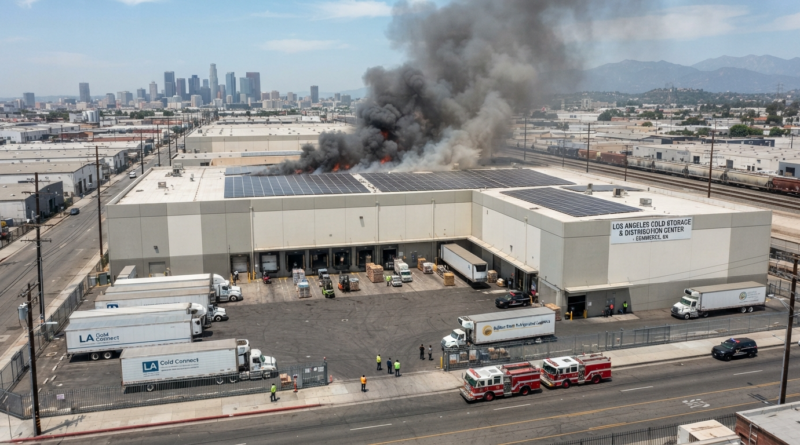
The Lineage Logistics warehouse in Boyle Heights caught fire while contractors serviced rooftop solar panels. By the time crews contained it seven days later, 85 million pounds of decomposing food was trapped inside a six-story shelving system, and Southern California was facing a capacity nightmare.
But here’s what the headlines missed: this wasn’t a one-off incident. It was a warning signal about the fragility of cold chain infrastructure across the continent.
The Numbers Behind the Squeeze
Los Angeles controls 19.4 million square feet of freezer capacity—down from 20.5 million square feet just 18 months prior. Yet it must serve:
- 22+ million Southern California consumers
- Ports of LA and Long Beach (the nation’s largest container gateways)
- Central Valley agriculture producers supplying nationwide distribution
- Pharmaceutical manufacturers requiring cold chain compliance
This is not overcapacity. This is a structural deficit.
Nationally, new cold storage construction peaked at over 10 million square feet in 2025—but net absorption fell far short. Vacancy rates have climbed for five consecutive years, reaching nearly 8% nationally by early 2026.
Meanwhile, LA’s inventory is aging out. The average cold storage building here is 52 years old—the oldest portfolio in the country. Developers have largely abandoned the market for the Sun Belt and Midwest, where land costs and labor are cheaper.
Result: LA’s median cold storage rent ($26–$32 per sq ft annually) is the highest in North America—nearly double Chicago’s rates and 30% above South Florida’s.
Your facility isn’t competing in a growth market anymore. It’s operating in a scarcity market.
What the Lineage Fire Actually Tells Us
The immediate disruption was severe:
- 13 days of decomposing inventory inside an operational facility
- 4,000 odor complaints filed with air quality regulators in two weeks
- Nearly 300 residents filed litigation alleging ammonia exposure, smoke damage, and property harm
- South Coast air quality board threatened fines up to $70,000 per violation
- City attorneys placed a lien on the property and launched cost recovery litigation
But the strategic lesson runs deeper.
Lineage—the world’s largest cold storage operator—controls roughly 8 million square feet across California, or 10% of its global footprint. The Boyle Heights facility alone represented about 1% of their global operation. By their own estimate, 30 other Southern California facilities absorbed displaced customers within weeks.
This worked for Lineage because they’re vertically integrated at scale.
For independent warehouse operators, a facility-level fire becomes an existential event.
The Regulatory Cascade Is Just Starting
California lawmakers are moving fast. Assembly Bill 817, now in committee, would require:
- Heightened permitting review for new cold storage development
- Mandatory contingency funds to support communities after industrial accidents
- Proximity restrictions near schools, homes, and small businesses
The Global Cold Chain Alliance and California’s food producer lobby are fighting the bill—arguing it will chill investment when the state already faces capacity constraints. But the political momentum is with stricter oversight.
Similar regulatory pressure is coming to other metros where cold storage density is high and community tolerance is low:
- Northeast Corridor: aging facilities near residential zones
- Upper Midwest: rapid consolidation by mega-operators (Lineage, Americold)
- Texas Growth Markets: new permits now requiring enhanced safety protocols
If you operate storage facilities, compliance costs are about to rise. The question is whether you’ll absorb them or pass them to customers.
Where Capacity Actually Exists (And Doesn’t)
Cold storage inventory concentration is extreme:
- Lineage + Americold: control nearly 4 billion cubic feet of North American capacity (roughly 40% of the market)
- Rexford Industrial + Dedeaux Properties: have exited or severely reduced cold storage holdings despite major LA industrial portfolios
- Regional independents: increasingly squeezed by pricing power of mega-operators and rising capital costs to maintain/upgrade aging stock
Geographic reality:
| Region | Capacity Trend | Rent Trend | Development Pace |
|---|---|---|---|
| Los Angeles | Declining | +30% in 2 years | Stalled |
| South Florida | Stable | $22–$25/sq ft | Moderate |
| Chicago | Growing | $13–$16/sq ft | Active |
| Sun Belt (DFW, ATL, Phoenix) | Expanding | $12–$18/sq ft | High |
| Upper Midwest | Stable | $10–$14/sq ft | Moderate |
The supply chain implication: East and West Coast customers are facing real constraints. Midwest and Sun Belt capacity is becoming the swing inventory for national networks.
What This Means for Your Warehouse Operations
1. Facility Resilience Is Now a Competitive Asset
Lineage could absorb the Boyle Heights loss. You may not be able to. Operators are now evaluating:
- Redundant refrigeration systems
- Fire suppression technologies (dry systems, inert gas, early detection)
- Backup power (generator capacity, solar + battery systems—carefully maintained)
- Insurance coverage adequacy
- Contingency arrangements with competitor facilities for emergency overflow
These are no longer optional amenities. They’re table stakes for contract retention.
2. Regional Scarcity = Pricing Power (For Now)
LA’s cold storage rents jumped 30% in two years. If you operate there, you have margin relief—but only temporarily.
Regulatory tightening (AB 817 and similar bills) will suppress new supply. That means:
- Existing facilities command premium pricing
- Replacement costs for aging stock become prohibitive
- M&A consolidation accelerates (your independent operator may be acquisition target)
3. Regulatory Costs Are Rising Across the Board
Contingency funds, enhanced permitting, proximity restrictions, emergency response protocols—all create operational friction and capital requirements that independent operators struggle to justify.
Larger operators can spread compliance costs. Smaller operators face margin compression.
4. Pharmaceutical and Specialty Foods Will Anchor Demand
Food producers can shop around for capacity. Pharma cold chain distribution, regulated by FDA and international compliance standards, cannot.
If your facility is approved for temperature-controlled pharmaceutical distribution, you have locked-in, price-inelastic demand. That’s increasingly valuable as general food storage commoditizes.
The Supply Chain Verdict
The Lineage fire didn’t create the cold storage crisis—it revealed one that was already building.
The structural facts:
- North American cold storage capacity is tight and aging
- Consolidation has reduced redundancy; mega-operators dominate supply
- New development is concentrated in low-cost regions, not demand centers
- Regulatory pressure will suppress new construction where it’s needed most
- Facility-level disruptions now ripple across dependent supply chains within days
For warehouse operators, this creates a two-track market:
Winners: Well-capitalized operators with redundant systems, regulatory compliance, and proximity to high-cost urban cores (LA, NYC, Boston). Scale and compliance become competitive moats.
Losers: Aging, under-capitalized facilities in high-regulation markets with no differentiation. These are acquisition targets or closures waiting to happen.
What To Do Now
If you operate cold storage facilities:
- Audit your redundancy. Can you survive a week-long facility outage? Do you have overflow capacity identified and pre-negotiated with other operators?
- Map regulatory exposure. Which states/cities are likely to follow California’s lead on contingency fund requirements and permitting restrictions? Budget for compliance costs now.
- Evaluate your customer mix. Food storage = commoditized pricing with volume churn. Pharma + specialty = premium pricing with contract stickiness. Which mix do you want?
- Consider consolidation scenarios. If you’re independent, larger operators are acquiring facilities in constrained markets. What’s your endgame—grow scale, specialize in premium verticals, or prepare for acquisition?
- Invest in facility intelligence. Real-time monitoring, predictive maintenance, and emergency protocols aren’t luxuries anymore. They’re insurance against the next fire.
The Bottom Line
One warehouse fire in LA exposed what industry experts have known for years: North American cold storage is under structural stress. Capacity is tight. Facilities are aging. Consolidation is accelerating. Regulation is tightening.
For operators, this isn’t a cyclical market downturn. It’s a fundamental reshaping of the competitive landscape.
The winners will be the ones who saw it coming.
Related Reading: